Loop, Out-and-Back or One-Way? Choosing a Shape for a Short City Walk
Choose a loop, out-and-back, or one-way city walk by matching its route shape to your destination, return options, and appetite for retracing.
A short city walk works better when its shape fits where you need to finish. For a city walk, choose a loop when you want to return near your starting point, an out-and-back when the destination itself is the point, and a one-way route when you need to end somewhere else. The choice is less about which shape is best than what you want the walk to do for the rest of your day.
Make that decision before comparing every street. A promising block can pull you off course, but a clear endpoint keeps the walk useful: back to the station, at a café, beside a friend’s office, or near the next errand. Start with your actual departure and arrival needs, then fit the route around them.
Choose the finish
Write down two places: where the walk begins and where you want to be afterward. The second place might be the starting point, a nearby destination, or a different part of the neighborhood. If you are meeting someone or catching transit, use the place you need to reach rather than an approximate district.
Now ask how you feel about walking over familiar ground. Retracing a street can be convenient and calming, especially if it is easy to follow. It can also make a short outing feel repetitive. A loop offers changing scenery, while a one-way route avoids the need to circle back. None of those preferences is a flaw; they are useful constraints.
Check what the walk must connect. A loop generally suits an outing that begins and ends near the same place. An out-and-back fits a destination with a natural return along the same corridor. A one-way walk suits a separate endpoint, provided you have a sensible way to continue from there.
Compare route shapes
Loop
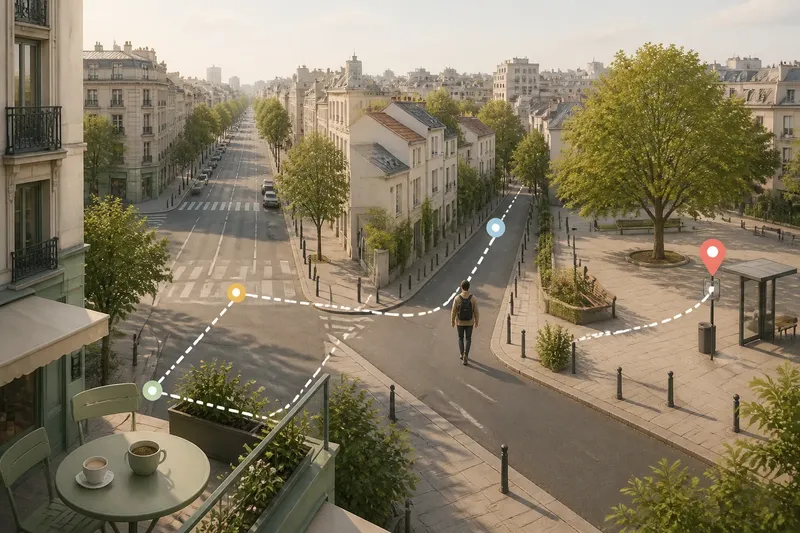
A loop leaves from a starting point and returns to its vicinity by a different set of streets. It is a good fit for a lunch break that begins and ends near the office, or for a neighborhood wander that should bring you back to a transit stop. The changing streets can make the outing feel varied without requiring a separate return plan.
Loops need a little attention at the point where they turn toward home. A map can make two streets look connected when a plaza, fenced property, limited crossing, or dead end complicates the walk. Trace the full route rather than assuming that a line drawn around several blocks will close neatly. Choose a return street that is easy to recognize, not merely one that completes the shape on a screen.
A loop can also leave you farther from your actual next stop than you expect. If you need to finish at a particular entrance, place that entrance at the end of the walk, even if the larger outline looks less elegant. A loop is useful only when its return point serves your day.
Out-and-back
An out-and-back follows a route to a destination and returns along much or all of the same path. It works well when the destination gives the walk its purpose: a public garden, a shop, a waterfront path, or a particular building. You can turn around there rather than spending time inventing a circuit.
This shape makes the return leg simple to understand, but it also means seeing familiar blocks again. That can be a benefit if you want an easy route to remember or prefer not to make additional turns. It may feel dull if the walk is mainly for discovering a neighborhood. Consider whether the destination gives you enough reason to accept that repetition.
Think through the return before setting out. A shop visit may take longer than expected, or the route may feel different once the light changes and storefronts close. Keep the same return route only if it still suits your circumstances; otherwise, a nearby transit stop or a different public street may offer a better continuation.
One-way
A one-way walk begins in one place and ends in another. It fits a walk to an appointment, a meeting with a friend, or a station you intend to use afterward. Because the endpoint is different, you avoid retracing, and the walk can connect two useful parts of the city rather than forming a closed shape.
Its tradeoff is that the end of the walking route needs a plan. Decide what happens after arrival: board transit, continue on foot, meet someone, or pause at the destination. Check that the endpoint is the right entrance or public access point, not just a nearby address pin. If the onward option changes, know whether you would rather walk farther or choose another stop.
A one-way route can also feel less settled if you are unsure how to get back to your starting point. You do not need to solve every possible change in advance, but identify a straightforward onward option before you leave. That small decision keeps the walk from ending in an avoidable scramble.
Build the route
Once the shape is clear, choose a destination or turning point. For a loop, pick a recognizable landmark on the far side of the circuit, such as a library entrance or a broad public square. For an out-and-back, mark the place where you intend to turn around. For a one-way walk, set the real arrival point and any onward connection before choosing streets.
Then trace a route that stays on walkable public streets and paths. Look for the crossings you will need, not just the length of the drawn line. A broad avenue may have limited crossings; a rail corridor or river may channel pedestrians toward particular bridges. Favor a route whose turns and crossings make sense on foot over one that appears tidy from above.
Use a map’s walking directions to check connectivity, then inspect the route visually. Search for a pedestrian entrance if a park path is part of the walk, and confirm that a passage is public rather than a private shortcut. A map pin can mark the center of a complex, not the door you need. Where access depends on a posted sign, the property owner’s directions, or local rules, follow those rather than treating a map line as permission.
Next, check the route against the conditions you can observe. A crowded market street may be pleasant when you have time and awkward when you are carrying a bag. A quiet side street may be easier to walk along but less useful if it has no obvious crossing where you need one. Choose streets that suit the purpose of this outing, not an abstract preference for the shortest line.
Finally, decide how much of the route you want to hold in mind. If you are comfortable following a map, note the key turn and endpoint. If you would rather look up less often, choose a route with recognizable streets and fewer changes of direction. There is no need to memorize every block. A couple of clear landmarks can make a short walk easier to resume after a stop.
Keep the plan flexible
Picture arriving at a public library on foot from a nearby station, then meeting a friend at a café elsewhere. If returning to the station matters, make a loop that passes the library and comes back along different streets. If the visit is the whole outing, walk to the library and retrace the route. If the café is the real endpoint, choose a one-way walk that reaches it directly. The same starting point supports three sensible shapes because the desired finish changes.
Keep one alternative in mind without turning the walk into a project. A loop can be shortened by turning back through the streets you already know. An out-and-back can end early at a useful stop. A one-way route can be adjusted toward a different transit connection if your destination changes. These are simple options, not extra itineraries to manage.
What is not worth the effort is bending a route into a perfect geometric shape. A neat circle on a map does not matter if it relies on a closed gate or ends far from where you need to be. Prioritize a clear arrival point, walkable connections, and a return or onward plan that you can explain to yourself without squinting at the map.
Questions to settle?
Which route shape is easiest to remember?
An out-and-back is often straightforward because the return follows familiar streets. A loop can also be easy if it uses recognizable landmarks and a small number of clear turns.
Can a loop finish at a different place?
A loop returns near its start, but it can still finish at a nearby stop or destination if that suits your plans. If the endpoint is substantially elsewhere, treat the route as one-way and plan what follows.
What if I do not know how long the walk will take?
Choose the endpoint first and allow room to shorten or extend the route as you go. Avoid tying the plan to an exact arrival time unless you have checked the route and account for the conditions you expect.
Is retracing always a drawback?
No. Repeating a familiar street can make an out-and-back easier to follow and can suit a walk centered on one destination. It is only a drawback when the repeated view or return path conflicts with what you want from the outing.
Make the choice
Before leaving, say the route in one sentence: “I’m walking back to where I started,” “I’m going there and returning the same way,” or “I’m finishing at a different place.” If that sentence matches your day, the route shape is doing its job. For a city walk, the practical choice is the one that places you where you want to be when the walking ends.
One final check can prevent a needless detour: look at the map’s endpoint, not just its route line, and make sure it lands on the side of the block or station you actually need. A walk’s shape may be simple; the useful finish is often a specific door, crossing, or entrance.