The Direct Route Is Not Always the Clear One
A direct route is not always the clearest route. Learn how landmarks and route structure can make city journeys easier to recall and follow.
A direct route can be harder to remember than one with a few extra turns. For city wayfinding, the difference often lies not in signs or landmarks, but in the route’s sequence: whether each stretch feels distinct enough to recall what comes next.
Route structure matters
A long, straight avenue can blur into a succession of similar blocks. You may keep moving in the right direction yet lose track of how far you have come. By contrast, a route that changes character—a busy avenue, a quieter side street, then a plaza—gives your memory separate segments to hold.
Turns can help create those segments, but only when they divide the journey into recognizable parts. A route with several arbitrary turns can be harder than a straight one. The useful distinction is not simply direct versus indirect; it is whether the route has a sequence you can recall without constantly checking a map.
Build a mental sequence
Describe a route as a small set of actions and transitions: leave the café, cross the avenue, follow the quieter street, then enter the station. This differs from memorizing a chain of visual markers. The focus is on the order of movement and on how each section connects to the next.
Try to keep the sequence tied to meaningful changes. A shift from a commercial street to a residential block may be easier to remember than several similar intersections. Street names can also help separate sections, especially when the route follows a named avenue for a long stretch.
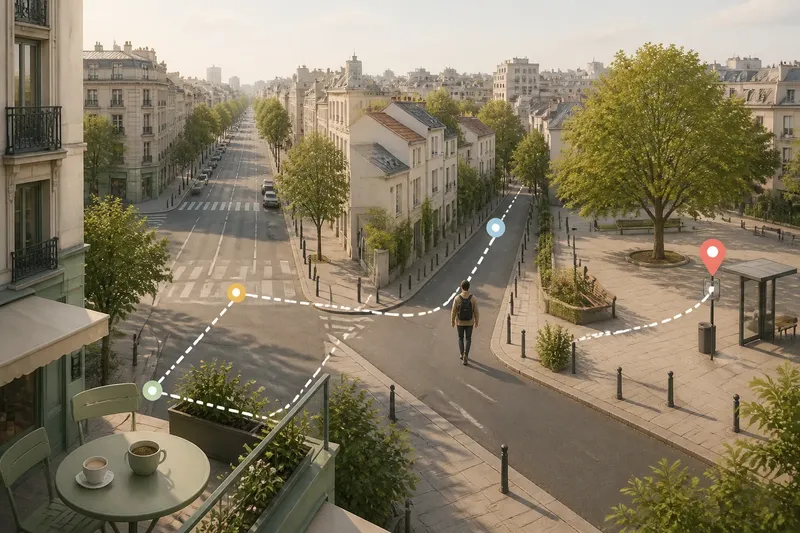
Say you are walking from a neighborhood café to a bus stop. Your invented route begins on a busy avenue, crosses at a major intersection, follows a quieter side street, and ends at the bus stop beside a plaza. You can recall it as three distinct movements rather than as an undifferentiated row of blocks. The observable result is a short route description that tells you what kind of movement comes next, even if a storefront or other visual detail changes.
Compare route options
When two routes look plausible on a map, compare how each is divided into parts. One may be shorter but consist of a long, repetitive stretch. The other may take a less direct line while offering clear changes in direction or street character. Neither form is automatically better; choose the one whose structure is easier for you to hold in mind.
- Long uniform stretch: If several blocks feel alike, then use a street name or a notable crossing to divide the stretch; otherwise choose a route with clearer section changes.
- Unclear turn sequence: If turns do not connect to a recognizable change in the route, then simplify the sequence; otherwise keep the turns that separate distinct sections.
- Street-name support: If the route follows named streets you can identify, then use those names as verbal markers; otherwise favor a route with fewer ambiguous transitions.
- Changing street character: If the route shifts clearly from one kind of street to another, then use that shift to remember the next segment; otherwise choose another dividing cue, such as a crossing or station approach.
- Arrival clarity: If the final approach is easy to distinguish from surrounding streets, then keep it as the route’s last segment; otherwise identify a different arrival point or compare an alternative route.
- Temporary disruption: If construction or a closure interrupts one segment, then follow current posted directions and reassess the route; otherwise keep the planned sequence.
It is not worth the effort to memorize every storefront, count every minor crossing, or rehearse a perfect spoken script. Those details add mental work without necessarily making the route easier to recover.
Questions about route memory?
Is the shortest route easiest to remember?
Not always. A short route can feel confusing if it runs through repetitive blocks, while a longer route may be easier to recall if its sections are distinct.
Do extra turns make a route harder?
They can, especially when several turns lead through similar surroundings. Turns are more useful when each one separates a clear part of the journey.
Should I memorize street names?
Street names can help you keep your place on a long avenue or identify a transition. Use them as support for the route sequence rather than trying to memorize every name along the way.
What should I do if the route changes?
Reassess the affected segment and follow current local directions where they apply. Then connect the next usable section to the journey’s overall sequence.
Choose a usable route
For city wayfinding, compare routes by how clearly they break into movements: where you begin, how the journey changes, and how you approach the destination. A direct line may still be the best choice, but its straightness is only one part of the decision.
Before leaving, name the route’s main sections in order. If you can describe how one section leads into the next without relying on a long list of visual details, you have a route structure you can carry with you—and adapt when the street does not look exactly as expected.